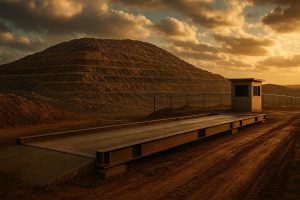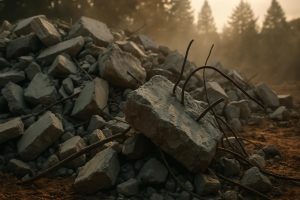
Aggregate is the backbone of construction. Roads, foundations, drainage systems, concrete mix, parking lots, and building pads all sit on or contain aggregate. By volume, it is the single most consumed construction material on earth. The United States alone uses roughly 2.5 billion tons of construction aggregate per year, according to USGS Mineral Commodity Summaries.
Most contractors buy aggregate from a quarry or supply yard. But every demolition project also produces raw material for aggregate. A jaw crusher turns concrete rubble into sized aggregate on-site. A vibratory screener separates it into spec products you can reuse or sell.
This guide covers all three aggregate types: natural, manufactured, and recycled. What each one is, how it is produced, standard sizes, and where each type gets used in the field.
What Is Construction Aggregate?
Construction aggregate is any granular material used as a component in construction. Sand, gravel, crushed stone, slag, recycled concrete, and manufactured stone all qualify. The common thread: sized, inert particles that provide bulk, strength, drainage, or structure when placed and compacted.
Aggregate serves two basic functions:
Structural: It distributes load and provides a stable base. Road base, sub-base, foundation pads, and backfill all rely on aggregate to transfer weight to the subgrade without settling or shifting.
Volumetric: In concrete and asphalt mix, aggregate makes up 60-80% of the total volume. It provides bulk and hardness while cement or asphalt binder holds the particles together.
The quality of the aggregate determines the quality of the finished product. Weak stone makes weak roads. Dirty aggregate makes bad concrete. Poorly graded base course fails under load. Everything downstream depends on the aggregate spec being right.
Three Types of Construction Aggregate
All aggregate falls into one of three categories based on its source and how it is processed.
Natural Aggregate
Mined directly from the earth. Pit-run gravel, river rock, and sand are natural aggregates. They form through geological processes: weathering, erosion, glacial deposits, and alluvial flows.
How it is produced: Extracted from open pits, riverbeds, or underwater deposits. Minimal processing. Washed and screened to remove clay, silt, and organic material, then sorted by size. No crushing required for rounded gravel and sand. Angular pit-run material may go through a primary crusher to produce specific sizes.
Characteristics: Rounded or sub-rounded particles (river gravel). Lower interlock than crushed stone because smooth surfaces do not grip as tightly. Excellent for drainage, concrete mix, and landscaping. Less ideal for road base where particle interlock matters.
Cost: $8-$20 per ton at the quarry gate, depending on size and region.
Manufactured (Crushed) Aggregate
Quarried rock run through crushers and screens to produce angular, sized particles. Limestone, granite, basalt, dolomite, and trap rock are the most common source stones.
How it is produced: Blasting breaks solid rock from the quarry face. Primary jaw crushers reduce the blasted rock from boulders to fist-sized pieces. Secondary crushers (cone or impact) reduce it further. Multi-deck vibrating screens sort the output into sized fractions: #57 stone, #67 stone, #8 stone, screenings, and other gradations.
Characteristics: Angular, fractured surfaces. High interlock when compacted. Superior load-bearing capacity compared to rounded natural aggregate. The standard material for road base, sub-base, concrete mix, and structural applications.
Cost: $12-$30 per ton at the quarry, depending on rock type and size.
Recycled Aggregate
Demolished concrete, brick, block, and masonry processed through a crusher and screen. Also called recycled concrete aggregate (RCA) when the source is concrete.
How it is produced: Demolition debris is collected, sorted to remove contaminants (wood, drywall, plastic), and fed through a jaw crusher. An overband magnet removes rebar and steel during processing. The crusher output is screened into sized fractions. See our complete concrete recycling process guide for the step-by-step walkthrough.
Characteristics: Angular particles similar to crushed stone. Slightly higher water absorption than virgin aggregate (4-8% vs. 1-3%). LA Abrasion loss typically 30-45%. Meets DOT base course specifications in all Southeast states. Accepted for concrete mix aggregate at limited percentages (20-30%) in most states.
Cost: $6-$15 per ton purchased. $5-$12 per ton self-produced with portable equipment.
Aggregate Type Comparison Matrix
| Factor | Natural (Pit-Run) | Manufactured (Crushed) | Recycled (RCA) |
|---|---|---|---|
| Source | Gravel pits, riverbeds | Quarried rock | Demolition concrete |
| Processing | Wash and screen | Blast, crush, screen | Sort, crush, screen |
| Particle shape | Rounded to sub-rounded | Angular | Angular |
| Cost per ton | $8-$20 | $12-$30 | $6-$15 |
| Load-bearing capacity | Moderate | High | High |
| Water absorption | 1-2% | 1-3% | 4-8% |
| Availability | Regional (deposit-dependent) | Widespread (quarry-dependent) | Anywhere concrete is demolished |
| DOT base approval | Yes | Yes | Yes (all SE states) |
| Environmental impact | Extraction disrupts land/waterways | Quarry blasting, trucking | Diverts landfill waste |
The cost advantage of recycled aggregate is clear. At $6-$15 per ton purchased (or $5-$12 self-produced), RCA runs 40-60% cheaper than virgin crushed stone. For base course, backfill, and pipe bedding, the performance is equivalent.
Standard Aggregate Sizes and Gradations
Aggregate sizing follows ASTM and AASHTO designation systems. Each number corresponds to a specific sieve analysis (the percentage of material that passes through each screen size). Here are the sizes contractors encounter most often.
| Designation | Nominal Size Range | Common Name | Typical Applications |
|---|---|---|---|
| #4 | 1.5 to 0.75 in | Railroad ballast stone | Railroad beds, heavy drainage |
| #57 | 1 to No. 4 sieve (0.187 in) | #57 stone | Concrete mix, base course, drainage, driveways |
| #67 | 0.75 to No. 4 sieve | #67 stone | Concrete mix, structural backfill |
| #8 | 0.375 to No. 16 sieve (0.047 in) | Pea gravel size | Asphalt mix, walking paths, drainage fill |
| #89 | 0.375 to No. 50 sieve | Fine drainage stone | French drains, pipe bedding |
| #10 | No. 4 to 0 (screenings) | Stone dust, screenings | Paver bedding, leveling course, fill |
| Crusher run | 1.5 in to dust | Dense-grade aggregate (DGA) | Road base, sub-base, driveway base, parking pads |
| Rip rap | 6 to 24 in | Armor stone | Erosion control, channel lining, slope protection |
Crusher run is the most used aggregate product in site work. It is the full output of a crusher: a blend of all sizes from the CSS maximum down to dust. The range of particle sizes interlocks and compacts into a dense, stable base. Most road base, driveway base, and parking lot sub-base specs call for crusher run or dense-grade aggregate.
For a deeper breakdown of sizes and what each one does, see our crushed stone sizes and grades guide.
How Aggregate Is Made: The Production Process
Whether the source is quarried rock or demolished concrete, the production process follows the same basic sequence: reduce, separate, stockpile.
Quarry Production (Manufactured Aggregate)
1. Drilling and blasting: Drill rigs bore holes into the quarry face. Explosives fracture the rock into manageable boulders. 2. Primary crushing: A jaw crusher reduces boulders from 3-4 feet down to 6-8 inches. Jaw crushers use compressive force: two steel plates (jaws) squeeze and crack the rock. 3. Secondary crushing: A cone crusher or impact crusher further reduces the material to finished sizes. Cone crushers produce cubical particles. Impact crushers produce more angular shapes. 4. Screening: Multi-deck vibrating screens sort the crushed output into sized fractions. Each deck has a different screen opening. Material passes through screens from top to bottom, with the largest sizes caught on upper decks and fines falling to the bottom. 5. Washing (optional): Some aggregate products are washed to remove clay, dust, and fines. Washed stone commands a premium price for concrete mix and decorative applications. 6. Stockpiling: Sized products are conveyed to separate stockpile areas. Wheel loaders fill trucks from each pile as orders come in.
On-Site Production (Recycled Aggregate)
Contractors can produce aggregate directly on demolition sites using portable equipment. The process is simpler than quarry production because demo concrete is already partially broken.
1. Demolition and sorting: Excavator breaks the structure and separates concrete from other debris. 2. Feeding: Excavator or wheel loader feeds broken concrete into a portable jaw crusher. 3. Crushing: The jaw crusher reduces concrete to the CSS target size. Integrated overband magnet removes rebar. 4. Screening (optional): A vibratory screener separates the crusher output into sized fractions. Skip this step if crusher run (full-range mix) is the target product. 5. Stockpiling: Sized aggregate is staged for immediate reuse on the same project or loaded for transport to other sites.
The difference: A quarry runs permanently at one location with stationary equipment worth millions. On-site recycling is temporary, using portable machines that set up in hours and move to the next job. The output quality is comparable when proper gradation control is maintained. For the full on-site crushing walkthrough, see our process and cost guide.
Applications by Project Type
Different projects need different aggregate products. This table maps the most common project types to the aggregate products they consume.
| Project Type | Aggregate Products Used | Notes |
|---|---|---|
| Road construction | Crusher run (base), #57 stone (drainage), #67 (concrete mix), screenings (shoulder) | DOT specs govern gradation |
| Residential foundations | Crusher run (base pad), #57 stone (drainage), sand (bedding) | 4-6 in compacted base typical |
| Commercial foundations | Crusher run (sub-base), #57 (structural fill), #67 (concrete mix) | Engineer specifies gradation |
| Parking lots | Crusher run (base), #57 stone (drainage), screenings (surface leveling) | 6-8 in compacted base typical |
| Drainage systems | #57 stone (French drains), #89 stone (pipe bedding), #8 (filter layer) | Sized stone prevents pipe clogging |
| Concrete production | #57 or #67 (coarse agg), sand (fine agg), cement, water | Aggregate is 60-80% of mix volume |
| Landscaping | #8 stone (paths), #57 (decorative beds), river rock, screenings (paver base) | Washed stone for visible applications |
| Utility trenches | #89 stone (pipe bedding), crusher run (backfill), sand (fine bedding) | Spec depends on pipe material |
| Erosion control | Rip rap (6-24 in), #4 stone (heavy drainage) | Sized to resist flow velocity |
Aggregate Testing: How Quality Is Verified
Aggregate is only as good as its test results. Three tests are standard across the industry.
Sieve analysis (ASTM C136): The most common test. A stack of progressively finer sieves shakes for a set time. The percentage of material retained on each sieve defines the gradation curve. Every DOT spec and concrete mix design references a sieve analysis. If the gradation falls outside the spec envelope, the material fails.
LA Abrasion (ASTM C131): Measures hardness. Steel balls rotate with aggregate samples in a drum. The percentage of material that breaks down to fines after 500 revolutions is the abrasion loss. Lower numbers mean harder stone. Most specs allow a maximum of 40-50% loss. Granite typically scores 15-25%. Limestone runs 20-35%. Recycled concrete aggregate hits 30-45%.
Specific gravity and absorption (ASTM C127/C128): Determines density and how much water the aggregate absorbs. High absorption affects concrete mix water ratios and freeze-thaw durability. Virgin crushed stone absorbs 1-3%. Recycled aggregate absorbs 4-8%.
When testing matters: DOT projects, commercial concrete mix, and any specification that references ASTM or AASHTO standards. For backfill, fill, and general site work, visual inspection and a proctor compaction test are often sufficient.
Producing Your Own Aggregate On-Site
Every demolition project creates feed material for aggregate production. A 2,000-square-foot concrete slab at 4 inches thick weighs roughly 50 tons. That is 50 tons of crusher run or sized aggregate waiting to be produced instead of hauled to a landfill at $25 to $80 per ton.
What you need:
- A jaw crusher. The Evortle CT-535 handles jobs under 200 tons. The Evortle CT-850 runs production pace on larger commercial work. Both process concrete, rock, brick, and block. Neither processes asphalt (that needs an impact crusher; see our crusher types guide).
- A vibratory screener (optional). If you need sized fractions instead of crusher run, a vibratory screener separates the crusher output. Skip the screen if full-range crusher run is the target.
- An excavator or wheel loader. To feed the crusher and manage stockpiles. Most demo sites already have one on-site.
The math works at 50 tons and above. Below 50 tons, buying aggregate from a supplier is typically cheaper than mobilizing a crusher. Above 50 tons, on-site production saves money on both disposal (no haul-out cost) and material (no aggregate purchase). At 200 tons, contractors typically save $5,000 to $10,000 compared to hauling out and buying back aggregate.
GrinderCrusherScreen connects contractors with portable crushing and screening equipment across the Southeast. Call 770-433-2670 to talk through your project and get matched with the right equipment. We have been in the equipment business since 1973.
Frequently Asked Questions
Aggregate vs gravel: what is the difference?
Gravel is one type of aggregate. All gravel is aggregate, but not all aggregate is gravel. Gravel refers specifically to naturally occurring rounded rock particles, typically from riverbeds or glacial deposits. Aggregate is the broader term that includes gravel, crushed stone, sand, slag, recycled concrete, and manufactured stone. When a spec calls for “aggregate,” it defines the exact gradation and properties needed. When someone says “gravel,” they usually mean rounded natural stone, though the term is used loosely in everyday conversation.
What is fine vs coarse aggregate?
Coarse aggregate is material retained on a No. 4 sieve (particles larger than 0.187 inches, roughly 3/16 of an inch). Fine aggregate passes through a No. 4 sieve. Sand is the most common fine aggregate. In concrete mix design, the ratio of coarse to fine aggregate affects workability, strength, and finish quality. A typical structural concrete mix uses roughly 60% coarse aggregate and 40% fine aggregate by weight, combined with cement and water.
Can you make aggregate from demolition concrete?
Yes. A jaw crusher processes demolished concrete into recycled concrete aggregate (RCA) that meets base course specifications in all Southeast states. The crusher reduces concrete slabs, walls, and footings to a target size set by the CSS (closed-side setting). An integrated magnet removes rebar. The output is structurally sound aggregate usable for road base, sub-base, backfill, pipe bedding, and structural fill. For a full walkthrough, see our concrete recycling process guide.
What is the most common aggregate size?
Crusher run (dense-grade aggregate) and #57 stone are the two most common aggregate products in construction. Crusher run is the default for base course, driveway construction, and sub-base layers because its blend of sizes from 1.5 inches to dust compacts into a dense, stable pad. #57 stone (1 inch to No. 4 sieve) is the standard for concrete mix, drainage, and backfill. Together, these two products account for the majority of aggregate consumed on construction sites. See our stone sizes guide for a full reference.
How is aggregate tested?
Three standard tests cover most applications. Sieve analysis (ASTM C136) measures gradation: the distribution of particle sizes. Every DOT and concrete spec references a gradation curve. LA Abrasion (ASTM C131) measures hardness by tumbling aggregate with steel balls and measuring the breakdown. Specific gravity and absorption (ASTM C127/C128) measures density and water uptake. For DOT base course, sieve analysis is the critical test. For concrete mix, all three tests apply. Testing is performed by certified labs and costs $100 to $300 per sample depending on the test suite.
—
Stop buying what you can produce. Every demolition project generates raw aggregate material. A portable jaw crusher and vibratory screener turn that rubble into spec product on-site, eliminating both disposal costs and aggregate purchase costs.
Browse concrete crushers on the GrinderCrusherScreen main site or check the crusher rental page for availability in your area. Call 770-433-2670. Since 1973.