On-site concrete crushing turns demo rubble into reusable base aggregate without leaving the jobsite. No trucks. No landfill. No tipping fees. Here is how the process works and what it costs.
Step 1: Site Assessment and Equipment Sizing
Every crushing job starts with two questions: how much material do you have, and what is in it?
Estimate your tonnage. A 4-inch concrete slab weighs roughly 50 lbs per square foot, or about 2.5 tons per 100 square feet. A 2,000-square-foot driveway is roughly 50 tons. A 10,000-square-foot commercial slab at 6-inch thickness is around 375 tons. These are working estimates. Thicker slabs, footings, and structural walls weigh more per square foot.
Identify the material. Plain concrete, rebar-reinforced concrete, and mixed loads with brick or block all crush fine in a jaw crusher. Rebar is not a problem. The integrated magnet pulls it out during processing. But know what you are feeding the machine before you pick one. Heavy rebar (number 8 bar and above) affects feed rate and jaw wear.
Pick the right machine. Two models cover most jobs:
- Under 200 tons, light to moderate rebar: Evortle CT-535. 14,330 lbs. Compact. 20×14-inch jaw opening. Rides on a standard tag-along trailer. Fits through residential gates and into tight job sites.
- Over 200 tons or heavy reinforced: Evortle CT-850. 52,910 lbs. Production machine. 32×20-inch jaw opening. Handles structural concrete, bridge decks, and warehouse foundations at volume.
Not sure about your tonnage? Our demolition tonnage estimation guide has formulas for slabs, footings, walls, and common demo scenarios.
Check site access. The CT-535 tows behind a one-ton pickup and fits anywhere a dually can go. The CT-850 ships on a lowboy and needs open access for a 53-foot trailer. Measure your gate width and check overhead clearance before you order.
Step 2: Equipment Delivery and Setup
Delivery depends on the model.
CT-535: Ships on a standard tag-along trailer. Your tow vehicle: a one-ton pickup or medium-duty truck. Many contractors tow the CT-535 with equipment they already own. No oversize permits. No pilot cars.
CT-850: Ships on a lowboy. Requires a flatbed or specialized heavy-haul trailer. The trucking company handles delivery and pickup. Plan for lowboy access at the site entrance.
Setup time: 30 to 60 minutes for either model. Position the crusher near the rubble pile with the discharge conveyor pointing toward your stockpile area. Level the machine. Connect power. Run a test cycle. That is it. No foundation work, no crane lifts, no complicated assembly.
You need a feeding machine on-site: an excavator with a thumb or a skid steer with a grapple bucket. The excavator picks up broken concrete and drops it into the crusher hopper. If you are running a demo job, you already have the excavator on-site. The crusher plugs into your existing workflow.
Step 3: Crushing Operations
This is where concrete turns into aggregate.
The excavator feeds broken concrete into the crusher hopper. Jaw plates close and crush the material to the set CSS (closed side setting). CSS controls the output size. Set the CT-535 to its minimum 0.8-inch CSS and you get road base aggregate. The CT-850 produces a 1-inch minus product at its tightest setting. Need a coarser output for large fill? Open the CSS up.
The magnet does the dirty work. An overband magnet sits above the discharge conveyor. The CT-850 includes the magnet as standard equipment; on the CT-535, it is an available option. As crushed material exits the jaw chamber, the magnet pulls rebar, tie wire, and steel reinforcement out of the stream automatically. Steel goes to a scrap pile. Clean aggregate conveys to your stockpile on the opposite side.
Throughput depends on the model and the material. The CT-535 runs at a pace that matches residential and small commercial work. One excavator keeps it fed without waiting. The CT-850 runs production pace on large commercial sites. It eats material as fast as a 30-ton excavator can feed it.
Crew size: two people. One operator runs the excavator and feeds the crusher. The crusher runs itself once material hits the hopper. A second person monitors the stockpile, manages the scrap steel, and handles site logistics. On smaller jobs, a single operator can handle both roles.
Step 4: Material Grading and Use
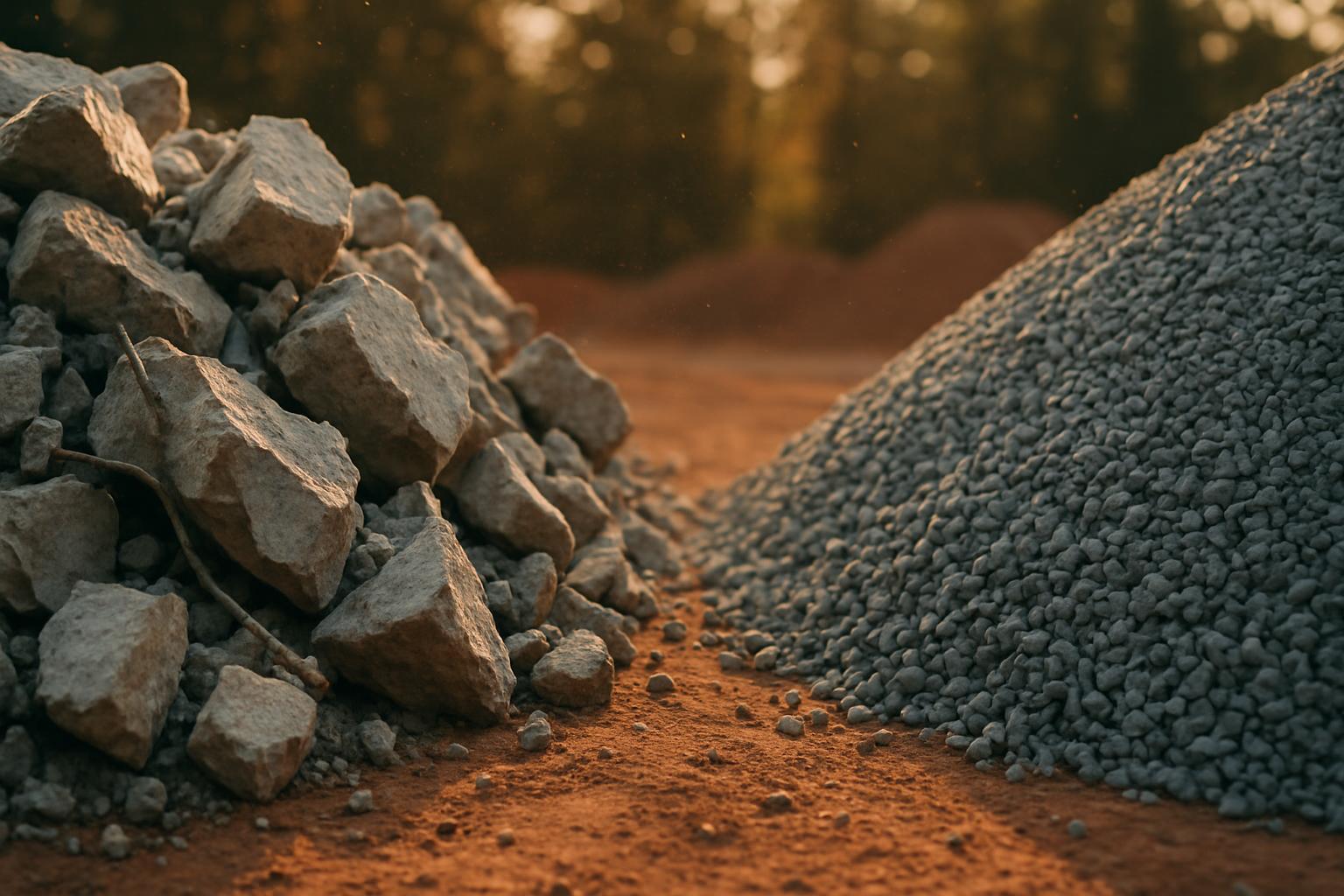
The crusher output is 3/4-inch minus aggregate: a mix of crushed concrete particles from dust up to 3/4-inch diameter. This material is structurally sound and usable on most projects without further processing.
Common uses for crushed concrete aggregate:
- Road base and sub-base
- Parking lot base course
- Pipe bedding
- Structural backfill
- Foundation backfill
- Temporary haul roads and construction access
Many DOT specifications accept crushed concrete as base material. Check your local DOT spec before crushing. If your project requires a specific gradation, adjust the CSS before you start processing. Run a test batch and check the output against your spec.
What to do with excess material. Crush what you need for the current job. If you produce more aggregate than you can use, stockpile it for future projects. Neighboring contractors on adjacent sites often take excess base material. Crushed concrete at about $12 per ton is cheaper than buying virgin aggregate, so the material has real value.
What On-Site Crushing Costs
Three cost components make up your all-in number.
Equipment rental. Weekly rates vary by model and market. The CT-535 costs less per week than the CT-850. Contact GrinderCrusherScreen at 770-433-2670 for current pricing in your area.
Fuel. Both models run on diesel. Consumption depends on material hardness, feed rate, and how many hours per day you run. Harder concrete and higher feed rates burn more fuel. Budget accordingly based on your tonnage estimate.
Operator. If you have a skilled excavator operator on your crew, they can feed the crusher. No specialized training needed beyond a brief orientation on the machine controls. If you do not have an operator, contracted crushing services include the operator and the machine as a package.
All-in cost per ton for on-site crushing: typically $5 to $12 per ton depending on volume, model, and whether you supply your own operator.
Compare that to hauling: $25 to $80 per ton all-in once you add tipping fees, trucking, loading time, and driver wait time at the landfill.
| Cost Component | On-Site Crushing | Haul-Out |
|---|---|---|
| Disposal/processing | $5-$12/ton | $15-$55/ton (tipping) |
| Trucking | $0 | $5-$8/ton |
| Loading time | Same (excavator feeds crusher or loads trucks) | Same |
| Wait time | $0 | $42-$125/load |
| Material value recovered | ~$12/ton | $0 |
The break-even point sits around 50 tons. Below that, hauling is often cheaper. Above 50 tons, the savings climb with every load you skip.
On-Site Crushing vs. Contracted Crushing
Two ways to get concrete crushed on your job site.
Option A: Rent the crusher. You provide the excavator, operator, and fuel. The crusher shows up on a trailer. You run it yourself. This costs less per ton but requires your own equipment and a skilled operator. Best for contractors who run demo work regularly and already have an excavator on-site.
Option B: Hire a contracted crushing service. A crushing operator brings the machine, runs it, and leaves when the job is done. Turnkey. You do not need your own excavator or operator. This costs more per ton but requires zero equipment investment from you. Best for one-off demo jobs or contractors without heavy equipment.
Which one fits your job? It depends on your tonnage, your equipment inventory, and your timeline. GrinderCrusherScreen connects you with both options. Tell us your tonnage, material type, and location. We will match you with a crusher rental or a contracted crushing operator, whichever fits.
Get Connected with a Crusher
GrinderCrusherScreen has connected contractors with heavy equipment since 1973. Whether you need to rent a jaw crusher or hire a contracted crushing crew, we match you with the right provider for your job.
Call 770-433-2670 or visit the concrete crusher rental page to request pricing.
Running a demo job in Atlanta, Nashville, or Tampa? We cover the entire Southeast.
Looking to buy instead of rent? Browse concrete crushers for sale on GrinderCrusherScreen.com.