Concrete disposal runs between $15 and $55 per ton at the gate. That number depends on your state, the type of facility, and how clean the material is. But that gate fee is only part of the story. Once you add trucking, loading, and driver wait time, most contractors pay $25 to $80 per ton all-in.
There is another option. Crush it on-site, skip the landfill entirely, and turn demo waste into usable base material. Here is a full cost breakdown of both approaches so you can run the numbers on your next job.
Concrete Disposal Cost Breakdown
Every haul trip has four cost layers. Most bids only account for the first one.
Tipping fees: $15 to $55 per ton. C&D landfills in the Southeast charge $15 to $30 per ton for clean concrete. Mixed loads with rebar, dirt, or wood waste push that to $40 to $55 per ton. Recycling centers that accept clean concrete typically charge $10 to $20 per ton, but they reject loads with contaminants.
Trucking: $4 to $6 per loaded mile (round-trip). A 20-ton end dump running 25 miles round-trip to the nearest C&D landfill costs $100 to $150 per trip. That is $5 to $7.50 added per ton just for the truck. Double the mileage and you double the freight cost.
Loading: $150 to $300 per hour. You need an excavator or skid steer with an operator to load trucks. A 150-ton job takes 8 loads in a 20-ton truck. At 20 to 30 minutes per load cycle, that is 3 to 4 hours of loader time: $450 to $1,200 depending on the machine and operator rate.
Wait time at the landfill: 30 to 60 minutes per load. During peak hours, trucks sit in line. At $85 to $125 per hour for a driver and truck, each wait adds $42 to $125 per load. Over 8 loads, that is $336 to $1,000 in dead time.
All-in cost per ton: $25 to $80. The exact number depends on haul distance, landfill rates in your area, load cleanliness, and how busy the facility is. But the gate fee alone never tells the full story.
Cost Comparison Table: Hauling vs. On-Site Crushing
This table shows total project costs at four common job sizes. Hauling assumes a 25-mile round-trip, $35/ton tipping fee, and $5/ton trucking. Crushing assumes weekly equipment rental, fuel, and operator costs.
| Job Size | Hauling (All-In) | On-Site Crushing | Net Savings | Savings % |
|---|---|---|---|---|
| 50 tons | $2,875 | $2,800 | $75 | 3% |
| 100 tons | $5,250 | $3,500 | $1,750 | 33% |
| 200 tons | $10,500 | $5,600 | $4,900 | 47% |
| 500 tons | $26,250 | $11,200 | $15,050 | 57% |
The break-even point sits right around 50 tons. Below that, hauling is usually cheaper or close to even. Above 50 tons, the savings from on-site crushing climb fast. At 500 tons, you are cutting your disposal cost by more than half.
These numbers do not include the value of the crushed material you keep on-site. More on that below.
What Jaw Crushers Actually Process
Before you rent a crusher, know what it handles and what it does not.
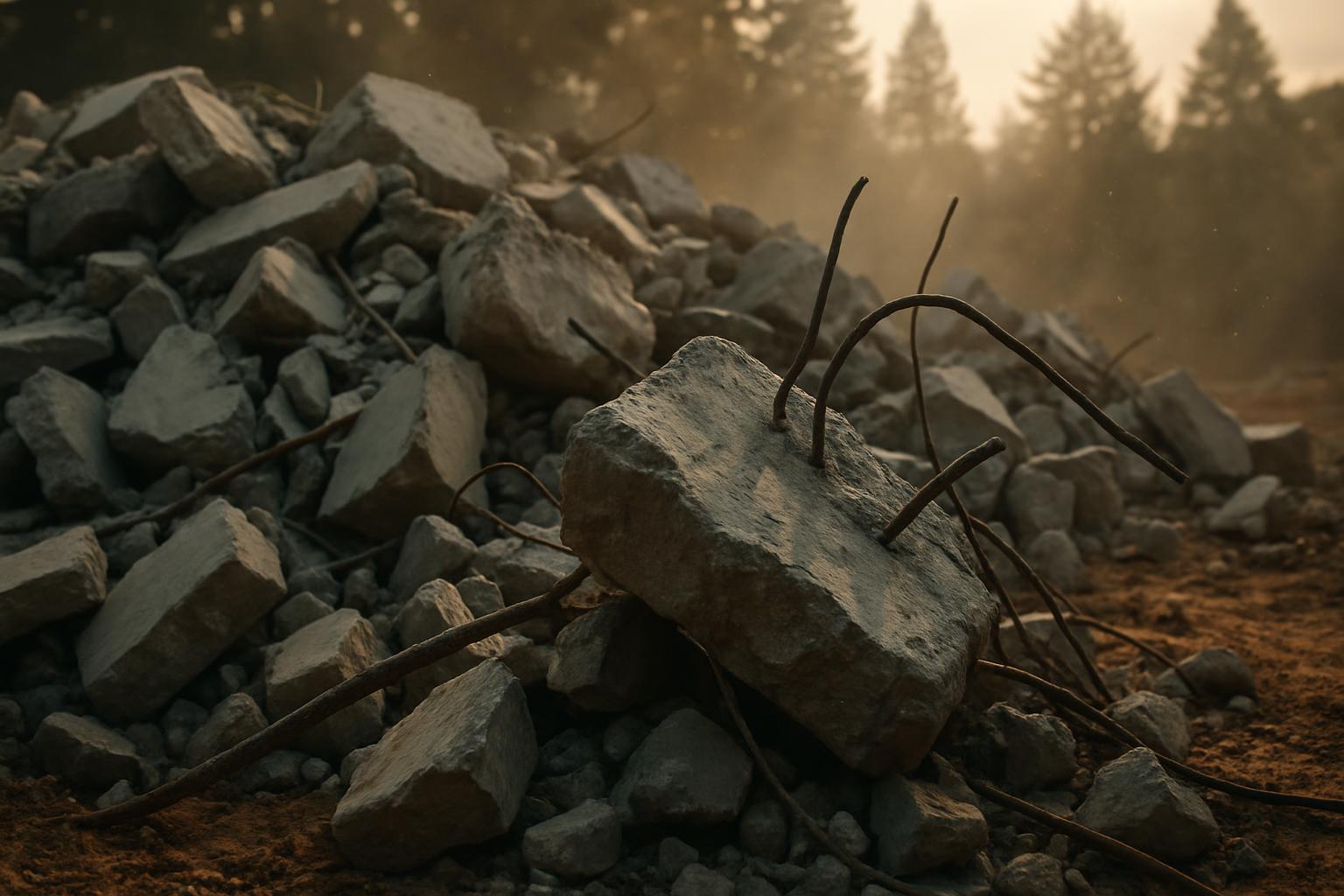
Concrete (plain and rebar-reinforced): YES. Jaw crushers process concrete slabs, footings, walls, and foundations. Rebar is not a problem. The CT-850 includes a standard cross magnet that pulls rebar during processing. The CT-535 offers an optional magnet for the same function. The steel goes to a scrap pile, and you get clean aggregate.
Rock, brick, block, and C&D rubble: YES. Natural stone, CMU block, brick, and mixed masonry all run through a jaw crusher. The machine does not care if it is poured or laid.
Asphalt: NO. Jaw crushers do not process asphalt. The material is too soft and sticky for a jaw chamber. Asphalt recycling requires an impact crusher, which uses a different crushing action. Do not try to run asphalt through a jaw crusher.
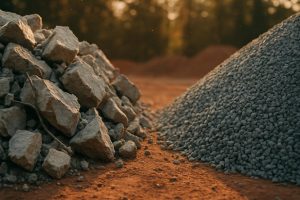
The output: 3/4-inch minus aggregate. Adjust the CSS (closed-side setting) and you get material sized for base course, backfill, pipe bedding, or spec aggregate. Most contractors use the crushed output as road base or structural fill right on the same job site. That means zero haul trips out and zero haul trips in for new base material.
Two Models, Two Job Sizes
GrinderCrusherScreen connects contractors with two Evortle jaw crusher models. Each one fits a different scale of work.
Evortle CT-535: 14,330 lbs. Compact enough to ride on a tag-along trailer behind a one-ton pickup. Designed for residential tear-outs, small commercial demo, and tight job sites where a full-size crusher will not fit. Ideal for jobs under 200 tons.
Evortle CT-850: 52,910 lbs. This is a production machine. It ships on a lowboy and processes material at rates that keep up with large commercial and municipal demo projects. Built for jobs over 200 tons where throughput matters.
Quick sizing rule: Under 200 tons, the CT-535 handles it. Over 200 tons, step up to the CT-850. If you are tearing out a residential driveway or a small parking lot, the CT-535 is the right fit. If you are demolishing a warehouse floor or a multi-story foundation, the CT-850 pays for itself in speed. Not sure how much concrete you have? Our tonnage estimation guide has formulas for slabs, footings, and walls. For a step-by-step process walkthrough, see how on-site crushing works.
The Math on a Real Job
Here is a side-by-side on a real-world scenario: a 150-ton parking lot tear-out in Atlanta, GA.
Option A: Haul It Out
- Loads: 150 tons / 18.75 tons per truck = 8 loads
- Tipping fees: $45/ton x 18.75 tons = $843.75 per load x 8 loads = $6,750
- Trucking: $135 per load x 8 loads = $1,080
- Loading time: ~4 hours at $200/hr = $800
- Total haul-out cost: $8,630
Option B: Crush On-Site
- Weekly crusher rental (CT-535): ~$3,200
- Fuel: ~$500 for the week
- Operator (if needed): ~$500
- Total crushing cost: $4,200
The Bottom Line
Net savings: $4,430. That is a 51% reduction in disposal cost.
But it gets better. The crushed concrete you produced is worth money. At $12/ton for 3/4-inch minus base material, that 150 tons of aggregate has a value of $1,800. Use it as backfill on the same site, and you also skip buying and hauling in new base material.
Total economic advantage: $6,230 when you count both the disposal savings and the recovered material value.
Contractors running demo work in the Southeast see these numbers on nearly every job over 100 tons. The further your job site sits from the nearest C&D landfill, the more the math favors on-site crushing.
Looking at a project in Tampa, Jacksonville, or anywhere else in the Southeast? The same math applies. Haul distances and tipping fees vary by county, but the break-even stays around 50 tons in most markets.
Get Matched with a Crusher for Your Next Demo Job
GrinderCrusherScreen has connected contractors with heavy equipment since 1973. Tell us about your job: tonnage, material type, location, and timeline. We will match you with a crusher and get you a quote.
Call 770-433-2670 or visit the concrete crusher rental page to request pricing.
Looking to buy instead of rent? Browse concrete crushers for sale on GrinderCrusherScreen.com.