
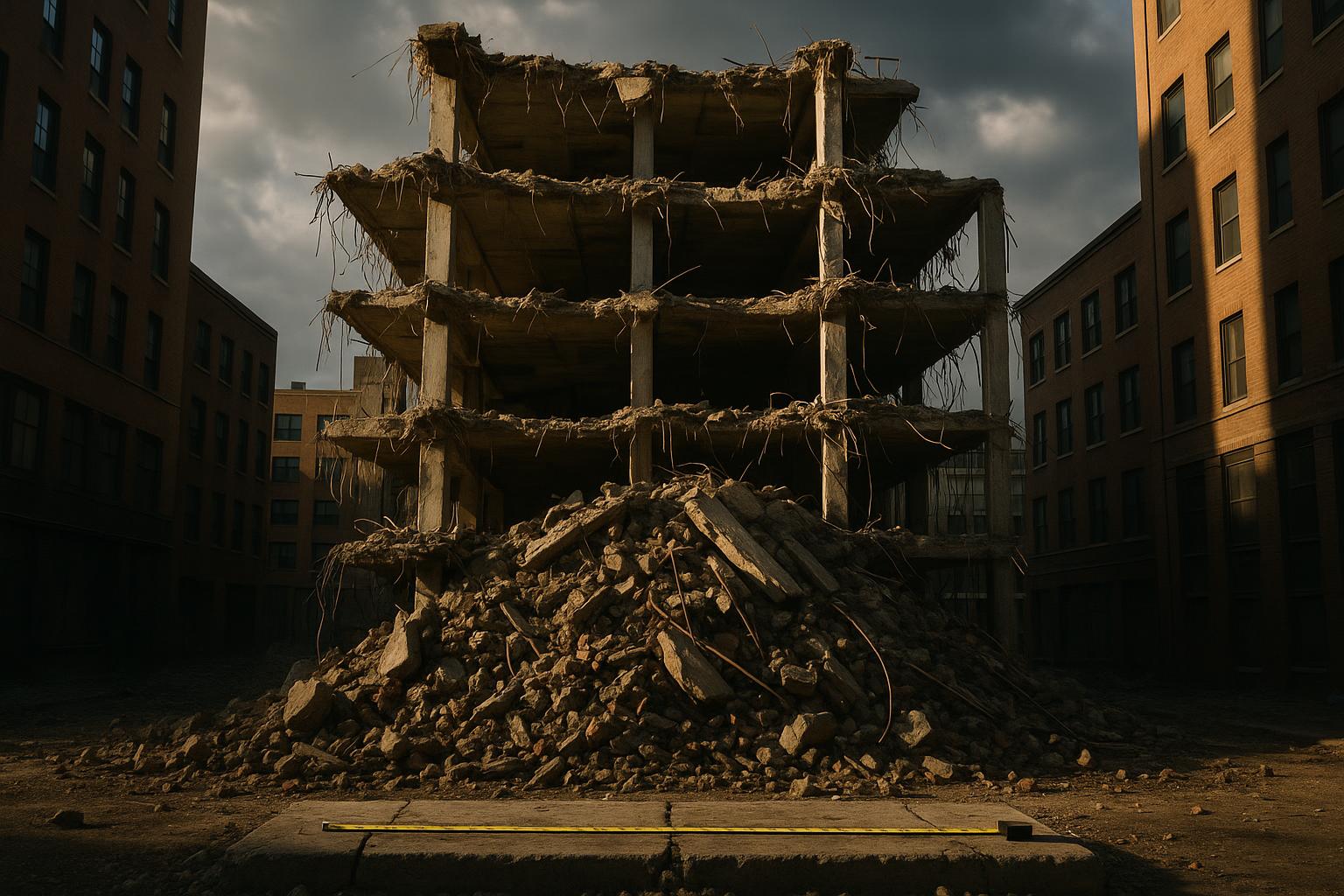
Every crusher quote starts with the same question: how many tons? Get the tonnage wrong and you rent the wrong machine, schedule the wrong number of days, and blow your disposal budget. Here is how to estimate concrete tonnage for common demo scenarios.
Concrete Weight Basics
Start with three numbers. Memorize them.
Standard concrete: 150 lbs per cubic foot. That works out to 4,050 lbs per cubic yard. This covers most slabs, footings, and foundations poured in the last 50 years.
Reinforced concrete: 155 to 160 lbs per cubic foot. Rebar mats, dowel bars, and wire mesh add steel weight. Most structural concrete is reinforced. Plan on 155 lbs/cu ft for anything with rebar in it.
Lightweight concrete: 110 to 120 lbs per cubic foot. You see this in precast panels, some roof decks, and older commercial tilt-up walls. Less common in slabs and foundations.
Quick conversion: 1 cubic yard of concrete weighs approximately 2 tons. That number gets you close enough for early-stage estimates. For bid-day math, use the exact formulas below.
Estimating Slab Tonnage
Slabs are the most common demo scenario. The formula is simple.
Length (ft) x Width (ft) x Thickness (ft) x 150 lbs/cu ft / 2,000 = tons
The only variable most guys miss is thickness. Here are common slab thicknesses by application:
- Residential driveway: 4 inches (0.33 ft)
- Residential garage: 4 to 6 inches
- Commercial parking lot: 6 to 8 inches
- Warehouse floor: 6 to 10 inches
- Industrial floor: 8 to 12 inches
Quick rule of thumb per 1,000 sq ft:
- 4-inch slab: ~25 tons
- 6-inch slab: ~37 tons
- 8-inch slab: ~50 tons
These three numbers will save you math on 90% of slab jobs. Multiply by the number of thousands of square feet and you have your tonnage.
Example: A 20,000 sq ft parking lot with a 6-inch slab. That is 20 x 37 = ~740 tons.
That is a big number. It also means a big crusher. More on equipment sizing below.
Estimating Foundation Tonnage
Foundations have more pieces than slabs. You need to estimate each component separately and add them up.
Continuous footings: Width (ft) x Depth (ft) x Linear feet x 150 / 2,000 = tons. A typical residential footing is 16 inches wide by 8 inches deep. A typical commercial footing runs 24 to 36 inches wide and 12 to 18 inches deep.
Stem walls: Height (ft) x Thickness (ft) x Linear feet x 150 / 2,000 = tons. Most residential stem walls are 8 inches thick and 18 to 24 inches tall above the footing.
Grade beams: Width (ft) x Depth (ft) x Span (ft) x 150 / 2,000 = tons. Grade beams run heavier than standard footings. They are typically 12 to 24 inches wide and 24 to 36 inches deep.
Spread footings (pads): Length (ft) x Width (ft) x Depth (ft) x 150 / 2,000 = tons per pad. Count the number of pads and multiply. Column pads on commercial buildings can weigh 2 to 5 tons each.
Example: A 2,000 sq ft house with a perimeter footing (160 linear feet of 16″ x 8″ footing) plus a 4-inch slab on grade. Footing: 160 x 1.33 x 0.67 x 150 / 2,000 = ~11 tons. Slab: 2,000 x 0.33 x 150 / 2,000 = ~50 tons. In practice, residential slabs often run 3.5 inches rather than a full 4 inches, which brings the slab closer to ~44 tons. Total comes to roughly 55 tons for the full residential tear-out (footing plus slab).
Estimating Block and Masonry Wall Tonnage
CMU walls are heavier than most guys expect. Here are the weights per square foot of wall face for 8-inch block:
- Ungrouted (hollow) 8-inch CMU: ~35 lbs per square foot
- Fully grouted 8-inch CMU: ~85 lbs per square foot
- Partially grouted (most residential): ~45 to 55 lbs per square foot
Know your wall type before you estimate. Fully grouted walls weigh more than twice what hollow walls weigh. Commercial and structural walls are almost always grouted.
Brick veneer adds roughly 40 lbs per square foot when you count the brick, mortar joints, and any grout fill.
Example: An 8-foot-high grouted CMU wall running 200 linear feet around a commercial building. Wall area: 200 x 8 = 1,600 sq ft. Weight: 1,600 x 85 / 2,000 = 68 tons.
That is just the walls. Add the foundation underneath and you could be looking at 80 to 100 tons for the full structure.
Common Demo Job Estimates: Quick Reference
Use this table for ballpark estimates before you pull out a tape measure.
| Demo Scenario | Size / Specs | Estimated Tonnage |
|---|---|---|
| Residential driveway | 400 sq ft, 4″ slab | ~10 tons |
| 2-car garage slab | 500 sq ft, 4″ slab | ~12 tons |
| Residential foundation + slab | 2,000 sq ft total | ~55 tons |
| Sidewalk | 500 linear ft, 4″ x 4′ wide | ~50 tons |
| Swimming pool (in-ground, concrete) | Standard residential | ~15 to 25 tons |
| Parking lot | 20,000 sq ft, 6″ slab | ~740 tons |
| Commercial building foundation | 10,000 sq ft | ~200 to 400 tons |
| Bridge deck section | 50 ft span, 24″ depth | ~150 to 300 tons per span |
Print this table. Stick it in your estimating folder. It will keep you from guessing.
How Tonnage Determines Equipment Size
Once you have your tonnage, you can pick the right crusher. Here is how the two Evortle jaw crusher models line up against common job sizes.
| Tonnage Range | Recommended Machine | Typical Duration |
|---|---|---|
| Under 50 tons | CT-535 | One day or less |
| 50 to 200 tons | CT-535 (multi-day) or CT-850 (faster) | 1 to 3 days |
| 200 to 500 tons | CT-850 | 3 to 7 days |
| 500+ tons | CT-850 (multi-week or contracted crushing) | 1 to 3 weeks |
The CT-535 weighs 14,330 lbs. It rides on a tag-along trailer behind a one-ton pickup. Built for residential and small commercial jobs.
The CT-850 weighs 52,910 lbs. It ships on a lowboy. This is a production machine for large commercial and municipal work. For material weight per cubic yard and how much each truck type can actually carry, see our truck payload and material weight guide.
When in doubt, call us with your tonnage estimate and material type. We size it and get you connected with the right equipment. 770-433-2670.
Common Mistakes in Tonnage Estimates
Five mistakes that blow estimates on demo jobs.
1. Forgetting rebar weight. Rebar adds 3 to 7% to the weight of a concrete structure. On a 500-ton job, that is 15 to 35 extra tons. Not a rounding error.
2. Ignoring sub-base material. Most slabs sit on 4 to 6 inches of compacted gravel. When you break out a slab, some of that base comes with it. If you are processing material through a crusher, the gravel adds volume and weight.
3. Not accounting for attached soil. Excavated footings and grade beams come out of the ground with soil clinging to them. Wet clay is heavy. A footer pull that should weigh 10 tons might weigh 13 tons by the time it sits in the pile.
4. Over-estimating by too much. It is better to estimate slightly over than under. But a 50% overestimate means you rented a bigger machine than you needed, or scheduled an extra day you did not use. That costs money.
5. Trusting the plans for slab thickness. A slab drawn at 4 inches on the structural plans is sometimes 5 or 6 inches as built. Concrete crews pour to grade, and grades are not always perfect. Measure the actual thickness at a break point or core hole before you bid. A 2-inch difference on a 10,000 sq ft slab adds 125 tons.
Get the Right Crusher for Your Tonnage
Know your tonnage and material type? GrinderCrusherScreen has connected contractors with the right equipment since 1973. Tell us the job details and we will match you with a crusher.
Call 770-433-2670 or visit the concrete crusher rental page to request a quote. Crushers are available in Tampa, Atlanta, Charlotte, and across the Southeast.
Want to see how on-site crushing compares to hauling on cost? Or need help figuring out concrete disposal costs for your bid? Those guides break down the full dollar math.
Looking to buy instead of rent? Browse concrete crushers for sale on GrinderCrusherScreen.com.