Crusher run is the workhorse of the aggregate industry. It sits under every road, parking lot, and building pad you have ever worked on. It is the single most ordered aggregate product at any quarry in the country. And most contractors use it without knowing exactly what it is or why it works.
This guide covers the specs, the science behind compaction, real costs, and how crusher run stacks up against alternatives.
What Crusher Run Actually Is
Crusher run is a blend of crushed stone and stone dust produced by running rock through a jaw crusher or cone crusher without screening out the fines. The output contains a continuous gradation from coarse aggregate (up to 1.5 inches) down to rock dust (particles smaller than the #200 sieve, about 0.003 inches).
That continuous gradation is the key. The fines fill the voids between the larger particles. When you compact it, the entire mass locks together into a dense, interlocking layer that resists movement under load.
Clean stone (like #57 or #67) does not do this. Clean stone has uniform particle sizes with air voids between them. It drains well, but it shifts under weight because nothing fills the gaps.
Crusher run fills the gaps. That is why it is the standard base material across every state DOT in the country.
Other names for the same product:
- ABC (Aggregate Base Course)
- GAB (Graded Aggregate Base)
- Dense Grade Aggregate (DGA)
- Road base
- Crush and run
- GDOT Graded Aggregate Base (Georgia spec)
- NCDOT ABC (North Carolina spec)
The name varies by state and by quarry. The product is the same: a crusher-produced blend of coarse and fine particles with a continuous gradation curve.
Crusher Run Gradation Specs
The gradation defines the product. Here is a typical AASHTO-based crusher run gradation, similar to what most Southeast state DOTs specify for base course material.
| Sieve Size | Percent Passing (Typical Range) |
|---|---|
| 1.5″ | 100% |
| 1″ | 80 to 100% |
| 3/4″ | 70 to 92% |
| 3/8″ | 50 to 75% |
| #4 (0.19″) | 35 to 60% |
| #10 (0.079″) | 20 to 45% |
| #40 (0.017″) | 10 to 30% |
| #200 (0.003″) | 5 to 15% |
What these numbers mean: 100% of the material passes through a 1.5-inch sieve (nothing is larger than 1.5 inches). 35 to 60% passes through the #4 sieve (about 3/16 inch). And 5 to 15% passes through the #200 sieve (the finest rock dust).
That 5 to 15% passing the #200 sieve is critical. Too few fines and the material does not lock together under compaction. Too many fines and it holds water, pumps under traffic, and loses stability in wet weather.
Always check your project spec. Georgia DOT, Florida DOT, and North Carolina DOT each have their own crusher run gradation envelopes. They are similar but not identical. A batch that passes GDOT spec might fail NCDOT spec at the #40 sieve. Get the right spec sheet from your engineer or DOT district before you order.
How Crusher Run Is Made
Two methods. Same result.
Method 1: Quarry production. A quarry blasts or excavates rock, feeds it through a primary jaw crusher, and collects the output without screening. The unscreened product is crusher run. Some quarries run the output through a secondary cone crusher to break down oversize pieces, but they still skip the screening step. The fines stay in the product.
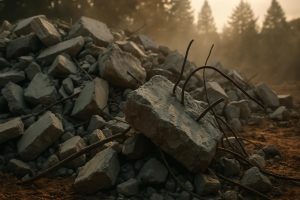
Method 2: On-site production from demolition concrete. A portable jaw crusher processes broken concrete, curb, sidewalk, or foundation material. The output contains crushed concrete pieces from 1.5 inches down to dust, with rebar removed by the magnet (standard on the CT-850, optional on the CT-535). This recycled crusher run performs identically to virgin material in most base course applications.
On-site production is where the economics get interesting. Instead of paying $25 to $42 per ton for quarry crusher run delivered to your site, you produce it from material already on the ground for $5 to $12 per ton all-in. Every ton of tipping fees you skip is another $35 to $55 saved.
Compaction: Why Crusher Run Works
Crusher run is a base material, not a surface material. It performs because it compacts.
Target compaction: 95% to 98% of Modified Proctor density. That is the standard most engineers and DOTs require for structural base courses. At 95%+ compaction, crusher run has a California Bearing Ratio (CBR) of 80 or higher. That means it supports heavy loads without deformation.
How to compact crusher run:
1. Spread in lifts. Never compact more than 4 to 6 inches at a time. For a 6-inch base, spread one 3-inch lift, compact it, then spread the second 3-inch lift and compact again. Two lifts give you better density than one thick pour. 2. Moisture matters. Crusher run compacts best at optimum moisture content, typically 6 to 10% by weight. Too dry and the particles will not slide into place. Too wet and the fines turn to mud and pump out under the roller. The surface should be damp, not muddy. A water truck helps on large pads. 3. Equipment selection. A vibratory plate compactor handles driveways and small pads. A vibratory smooth drum roller handles parking lots and road base. Minimum 3 to 5 passes across the full surface. More passes on clay subgrade. 4. Test the result. On commercial and DOT work, a nuclear density gauge confirms you hit 95%+ compaction. On residential work, the boot test works: walk across the compacted surface. If your boot leaves an impression deeper than 1/8 inch, it needs more passes.
Crusher run settles after compaction. Expect 15 to 25% settlement from loose volume to compacted volume. If you need 6 inches of compacted base, spread 7.5 to 8 inches of loose material. This settlement factor matters when you calculate how many tons to order. Crusher run weighs 2,500 to 2,900 lbs per cubic yard depending on moisture. See material weights per yard and truck payload limits to confirm your truck can handle the load.
Where Crusher Run Is Used
Crusher run goes under things. It is a structural base, not a finished surface. Here are the primary applications.
Road base and sub-base. Every paved road sits on a compacted aggregate base. Crusher run (labeled ABC or GAB on the plans) forms the structural layer between the subgrade soil and the asphalt or concrete surface. Typical thickness: 6 to 12 inches depending on traffic volume and soil conditions.
Parking lot base. Same application as road base. Most commercial parking lots use 6 to 8 inches of compacted crusher run under 2 to 4 inches of asphalt. Heavy-duty truck lots and loading areas need 10 to 12 inches.
Building pads. Compacted crusher run creates a stable platform for slab-on-grade construction. Common on warehouse, retail, and residential slab foundations. Typical depth: 4 to 8 inches.
Driveway base. The bottom layer of a proper gravel driveway is 4 to 6 inches of compacted crusher run, topped with 2 to 3 inches of #57 or #67 clean stone as the wearing surface.
Pipe bedding and backfill. Crusher run provides stable bedding for storm drain, sanitary sewer, and water line installations. It supports the pipe uniformly and resists settlement.
Temporary haul roads. Construction access roads take heavy truck traffic over soft ground. Six inches of crusher run on geotextile fabric creates a haul road that lasts through a full project without rutting out in the first rain.
Backfill behind retaining walls. Crusher run drains better than native soil and compacts against the wall for structural support. Some engineers spec clean stone behind walls instead, depending on drainage design.
Crusher Run Cost
Crusher run is typically the cheapest aggregate product at any quarry. It is unscreened, which means the quarry skips an entire processing step.
| Cost Component | Price Range | Notes |
|---|---|---|
| Crusher run (pickup at quarry) | $12 to $25/ton | Lowest at high-volume quarries near metro areas |
| Crusher run (delivered, 20 mi) | $25 to $42/ton | Delivery adds $150 to $350 per tri-axle load |
| Recycled crusher run (pickup) | $8 to $18/ton | Produced from demolition concrete at recycling yards |
| On-site produced (your crusher) | $5 to $12/ton | Equipment rental + fuel + operator. No haul cost. |
Volume pricing applies. Orders over 100 tons often run $2 to $4 per ton cheaper. Over 500 tons, negotiate a project rate. Quarries want the volume.
Delivery math: A tri-axle dump truck carries 18 to 22 tons per load. At $250 per delivery within 20 miles, that is about $12 to $14 per ton just for trucking. On a 500-ton parking lot base, delivery alone costs $6,000 to $7,000. This is why on-site production from demolition concrete changes the economics on demo and rebuild projects. Zero haul trips. Zero delivery charges.
Cost Comparison: Crusher Run vs. Alternatives
| Material | Cost/Ton (Delivered) | Compaction | Drainage | Load Bearing | Best For |
|---|---|---|---|---|---|
| Crusher Run (ABC) | $25 to $42 | Excellent (95%+) | Moderate | Excellent | Road base, parking lots, building pads |
| Clean #57 Stone | $30 to $50 | Poor (shifts) | Excellent | Poor without confinement | Drainage, pipe bedding, surface course |
| Recycled Concrete (screened) | $18 to $30 | Excellent | Moderate | Excellent | Base course, same as virgin crusher run |
| Recycled Concrete (unscreened) | $10 to $22 | Good to excellent | Moderate | Good to excellent | Fill, temp roads, non-spec base |
| Pit Run Gravel | $15 to $30 | Fair | Fair | Fair | Rural roads, non-structural fill |
| #3 Drainage Stone | $38 to $60 | None (open grade) | Excellent | Poor | French drains, septic fields |
Recycled concrete performs on par with virgin crusher run in most base course applications. Multiple state DOTs (including Florida and North Carolina) have approved recycled concrete aggregate for use in base course under DOT spec, provided it meets gradation and contamination limits.
Crusher Run vs. Gravel: The Real Difference
Contractors use “gravel” loosely. It means different things depending on context. Here is the technical distinction.
Crusher run is mechanically crushed rock with angular, sharp-edged particles and a full range of fines. The angular faces interlock under compaction. It is an engineered product with a controlled gradation.
Gravel (pit run or bank run) is naturally weathered, rounded stone dug from a pit or riverbed. The particles are smooth. They roll against each other instead of interlocking. Gravel compacts less effectively and has unpredictable gradation because nature does not run a quality control program.
The practical difference: Crusher run stays put under load. Gravel moves. A loaded concrete truck will rut through 6 inches of pit run gravel on the first trip. Crusher run handles it without flinching.
For any application with structural requirements (roads, parking, building pads), specify crusher run, ABC, or GAB. Save the pit run gravel for rural driveways and non-structural fill.
Coverage: How Much Crusher Run Do You Need
Crusher run coverage depends on the compacted depth.
| Compacted Depth | Tons Per 100 Sq Ft | Tons Per 1,000 Sq Ft | Notes |
|---|---|---|---|
| 2 inches | 1.0 to 1.2 | 10 to 12 | Thin leveling course only |
| 4 inches | 2.0 to 2.4 | 20 to 24 | Light residential (walkways, patios) |
| 6 inches | 3.0 to 3.6 | 30 to 36 | Standard driveway and light commercial base |
| 8 inches | 4.0 to 4.8 | 40 to 48 | Parking lots, medium commercial |
| 12 inches | 6.0 to 7.2 | 60 to 72 | Heavy commercial, DOT road base |
Remember the settlement factor. Loose crusher run settles 15 to 25% during compaction. To get 6 inches of compacted base, spread about 7.5 to 8 inches of loose material. Order tonnage based on the loose depth, not the compacted depth.
Quick formula: Compacted depth (inches) / 12 x area (sq ft) x 135 lbs per cu ft / 2,000 = tons. Then add 15 to 20% for settlement and waste.
For detailed tonnage calculations across multiple materials and job types, see the crushed stone calculator and tonnage guide.
Frequently Asked Questions
How thick should crusher run be for a driveway base?
Four to six inches of compacted crusher run is standard for residential driveways. Six inches handles regular passenger vehicle traffic on stable soil. If the subgrade is soft clay or organic material, go to 8 inches or add geotextile fabric underneath to prevent migration. Heavy vehicles (concrete trucks, moving trucks, RVs) need the full 6-inch base minimum. Always compact in two lifts: spread half the depth, compact, spread the other half, compact again.
Does crusher run need compacting?
Yes. Always. Uncompacted crusher run will shift, rut, and settle unevenly under traffic. Compaction is what activates the interlocking properties of the angular particles and fines. Use a vibratory plate compactor on driveways and small areas. Use a vibratory smooth drum roller on roads and parking lots. Target 95% Modified Proctor density. Minimum three passes across every section. Five passes on clay subgrade or soft soils. Moisture content should be 6 to 10% for best compaction. Damp, not soaked.
Crusher run vs gravel: what is the difference?
Crusher run is mechanically crushed rock with angular particles and a full range of fines from dust to 1.5 inches. It compacts into a solid, load-bearing mass. Gravel is naturally rounded stone from a pit or riverbed. It has smooth particles that roll against each other instead of interlocking. Crusher run stays locked under load. Gravel moves and ruts. For any structural base (roads, parking lots, building pads, driveway bases), crusher run is the correct choice. Gravel works for non-structural applications like rural roads, landscape fill, and temporary access where load-bearing performance is not critical.
Can you make crusher run from recycled concrete?
Yes. Every ton of demolition concrete your crew produces can become crusher run on-site. A portable jaw crusher with a CSS (closed side setting) in the 0.8-inch to 1.5-inch range produces a graded output from coarse aggregate down to fines, with rebar removed by the magnet (standard on the CT-850, optional on the CT-535). The result is recycled crusher run that compacts and performs like virgin quarry material. Multiple state DOTs accept recycled concrete as base course material when it meets gradation and contamination specs. On-site production costs $5 to $12 per ton versus $25 to $42 per ton for delivered quarry product. On a 500-ton parking lot base, that is $8,000 to $15,000 in savings. See how concrete recycling works for the full process.
What does a ton of crusher run cover?
One ton of crusher run covers approximately 80 to 100 square feet at 2 inches compacted depth, or 40 to 50 square feet at 4 inches compacted depth. The exact coverage depends on the specific gradation, moisture content, and how much the material settles during compaction. For planning: figure 1 ton per 100 square feet per 2 inches of compacted depth. A 1,000-square-foot driveway base at 6 inches compacted depth requires roughly 30 to 36 tons. Always order 10 to 15% extra to account for uneven subgrade, edge waste, and compaction settlement.
Produce Crusher Run On Your Jobsite
Stop hauling demo concrete to the landfill and buying virgin aggregate from the quarry. A portable jaw crusher turns the rubble pile into DOT-spec base material on the same site, the same day.
GrinderCrusherScreen has connected contractors with portable crushers since 1973. Tell us your tonnage and material type. We match you with the right equipment for the job.
Call 770-433-2670 or visit the concrete crusher rental page to request pricing.
Looking to buy? Browse concrete crushers for sale on GrinderCrusherScreen.com.