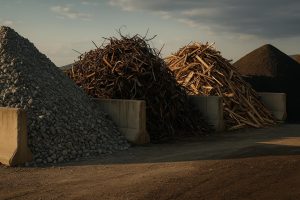
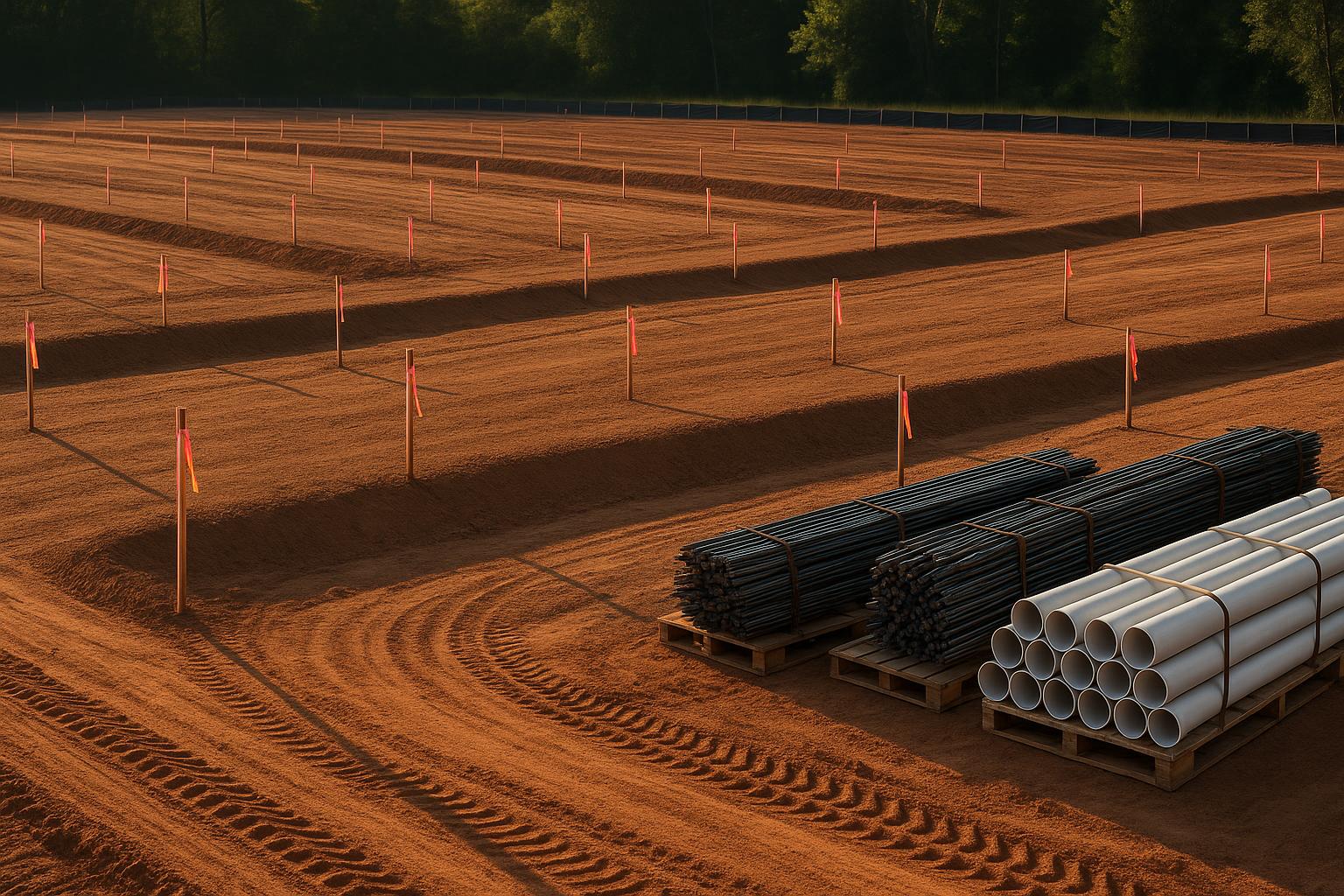
Site prep has four phases: clear, demolish, process, and grade. Each phase needs different equipment. Getting the sequence wrong costs time and money. Skipping Phase 3 costs even more.
Most contractors nail Phases 1 and 2. They clear the trees, knock down the structure, and pile everything up. Then they call 15 trucks to haul it all to a landfill at $45 a ton. The material they just paid to throw away is the same material they need to buy back in Phase 4.
This guide walks through each phase, the equipment it requires, and where on-site processing keeps dollars on your job site instead of at the dump.
Phase 1: Clearing (Trees, Brush, Vegetation)
The first machine on a raw site is usually an excavator with a grapple or a forestry mulcher. Chainsaw crews handle select trees. A mulcher handles everything else: saplings, brush, underbrush, small-diameter timber.
The output is wood waste. Lots of it. A 5-acre wooded lot produces hundreds of cubic yards of vegetative debris. For a full cost breakdown by terrain type, see our land clearing cost per acre guide. You have three choices for dealing with it:
1. Haul it out. Expensive. A 500-cubic-yard brush pile fills 25 trucks. 2. Chip it. Slow. A chipper handles limbs, not stumps or root balls. 3. Burn it on-site. Fast. An air curtain burner reduces 500 cubic yards to a few yards of ash.
For wood waste disposal, air curtain burners are the fastest option. The Merris WX-5 handles small residential and commercial sites. The WX-8 handles large commercial and land-clearing projects with heavy timber volume.
Air curtain burners hold temperatures above 1,800 degrees F. The air curtain traps particulates. Most states approve them in counties where open pile burning is banned. One unit replaces 20+ haul trips.
Skip this phase if the site is already cleared or previously developed. Go straight to Phase 2.
Phase 2: Demolition (Existing Structures)
Demolition equipment depends on the structure. Common setups:
- Concrete slab or foundation: Excavator with a hydraulic breaker
- Steel-frame building: Excavator with a hydraulic shear
- Block or masonry: Excavator with a breaker or a standard bucket
- Residential teardown: Skid steer, loader, and a demo crew
The output is piles of concrete, block, brick, and rebar-reinforced rubble. On a commercial demo, expect 100 to 500 tons of material. On a bridge deck or parking garage, expect more.
Here is the critical decision point: do not haul this material off-site yet. Every ton you send to a C&D landfill costs $35 to $55 in tipping fees plus trucking. Every ton you process on-site becomes free base material for Phase 4.
Move everything to a central staging area. Stack it where the crusher can reach it. Process it in Phase 3.
Phase 3: On-Site Processing (Crushing and Screening)
This is where most contractors leave money on the table. The rubble from Phase 2 and the soil from excavation are not waste. They are raw material. For a full rundown of what you can and cannot recycle on-site, see our C&D waste recycling guide.
Concrete and Masonry: Jaw Crusher
A portable jaw crusher converts demolition rubble into spec base aggregate. The excavator feeds broken concrete into the hopper. The crusher outputs 3/4-inch minus material, clean and ready for compaction.
Two models fit most site prep work:
- Evortle CT-535: Compact unit at 14,330 lbs. Tows behind a pickup on a tag-along trailer. Sized for residential demo, driveways, foundations, and small commercial pads.
- Evortle CT-850: Production unit at 52,910 lbs. Requires a lowboy for transport. Sized for large commercial demo, parking structures, and municipal infrastructure.
The CT-535 processes 120 to 240 tons per day depending on the target product size. The CT-850 handles 500 to 1,000 tons per day at production pace.
One note: jaw crushers process concrete, block, brick, and rock. They do not process asphalt. Asphalt requires an impact crusher.
Browse available concrete crushers in the Southeast.
Soil and Mixed Material: Trommel Screen
A trommel screen separates mixed excavation material into clean fractions. Soil, aggregate, roots, and debris feed into a rotating drum. Clean topsoil falls through the screen. Oversized material (rocks, roots, debris) exits the end.
Two models cover the range:
- CZ Screen MDS MIDI: Compact trommel for residential lots, utility projects, and tight sites with limited space.
- Screen USA TROM 512: Production trommel for large commercial sites, subdivision grading, and high-volume screening.
Screening turns mixed fill into two products: clean topsoil for finish grading and clean aggregate for base prep. Both go straight into Phase 4.
Browse available trommel screens in the Southeast.
The Result
Phase 3 output replaces two purchases you would otherwise make:
1. Crushed aggregate for subgrade and base prep (normally $8 to $15 per ton, delivered) 2. Screened topsoil for finish grading (normally $15 to $25 per cubic yard, delivered)
You already own the material. You just need the equipment to process it.
Phase 4: Grading and Base Prep
Phase 4 is standard earthwork: dozer, grader, compactor, water truck. The difference is where your material comes from.
Without Phase 3: You haul out all demolition debris (paying tipping fees and trucking), then haul in imported aggregate and topsoil (paying material costs and trucking again). Two-way trucking. Two invoices.
With Phase 3: You spread the crushed aggregate from your own rubble as subgrade and base material. You spread the screened topsoil from your own excavation spoils for finish grading. Zero import costs. Zero export costs.
The dozer pushes your processed material into place. The grader brings it to spec. The compactor locks it down. Same Phase 4 workflow, but the material bill drops to zero.
Equipment Sizing by Project Type
Not every site needs every machine. Here is a quick sizing reference.
| Project Type | Acreage | Crusher | Trommel | Air Burner |
|---|---|---|---|---|
| Residential lot | 0.25 to 1 acre | CT-535 | MDS MIDI | WX-5 (if wooded) |
| Small commercial | 1 to 5 acres | CT-535 or CT-850 | MDS MIDI | WX-5 |
| Large commercial | 5 to 20 acres | CT-850 | TROM 512 | WX-8 |
| Municipal / infrastructure | 20+ acres | CT-850 | TROM 512 | WX-8 |
On previously developed sites with no trees, skip the air burner. On sites with no existing structures, skip the crusher. Match the equipment to the material on your site.
What This Saves You
On-site processing eliminates four cost categories that bleed demo and site prep budgets:
- Tipping fees: $35 to $55 per ton at Southeast C&D landfills
- Trucking (outbound): $4 to $6 per mile round-trip per 20-ton load
- Imported aggregate: $8 to $15 per ton, delivered
- Imported topsoil: $15 to $25 per cubic yard, delivered
Real Example: 5-Acre Commercial Site Prep
A 5-acre commercial demo produces roughly 300 tons of concrete rubble and 200 cubic yards of mixed excavation soil. Here is the math without on-site processing:
| Cost Category | Calculation | Total |
|---|---|---|
| Tipping fees (concrete) | 300 tons x $45/ton | $13,500 |
| Trucking (outbound) | 15 loads x $270/load | $4,050 |
| Imported aggregate | 300 tons x $15/ton | $4,500 |
| Imported topsoil | 200 cu yd x $20/cu yd | $4,000 |
| Trucking (inbound) | 20 loads x $270/load | $5,400 |
| Total disposal + import cost | $31,450 |
With a crusher and trommel on-site, the tipping fees, trucking, and material purchases drop to near zero. Equipment rental for a week runs $10,000 to $15,000 depending on the models. That leaves $16,000 to $21,000 in net savings on a single job.
The math gets better on larger projects. It also gets better when the nearest C&D facility is 30+ miles from the job site.
Get the Right Equipment on Your Site
GrinderCrusherScreen has connected contractors with portable crushers, trommel screens, and air burners since 1973. Need a CT-535 for a residential demo in Atlanta? A CT-850 and TROM 512 for commercial site prep in Jacksonville? A trommel for screening soil in Charlotte? We match you with a provider who delivers to your job site.
Call 770-433-2670 to get sized for your next site prep project. Or browse equipment and pricing on the main site.