The EPA estimates 600 million tons of C&D debris are generated in the United States every year. The EPA reports that about 76% of C&D debris was directed to next use in 2018. With proper sorting, recovery rates above 90% are achievable on individual job sites. Yet much of it still goes to landfills.
The reason is simple. Hauling demo debris to a recycling facility costs as much as dumping it. By the time you pay for trucking, gate fees, and lost production time on the job site, there is no financial incentive to divert.
On-site processing changes the math. A crusher, a screener, or an air burner on the demo pad lets you recycle material where it sits. No haul trips. No tipping fees. No gate lines. This guide breaks down exactly what you can recycle on-site, what still needs a facility, and how the dollars work.
What Counts as C&D Waste
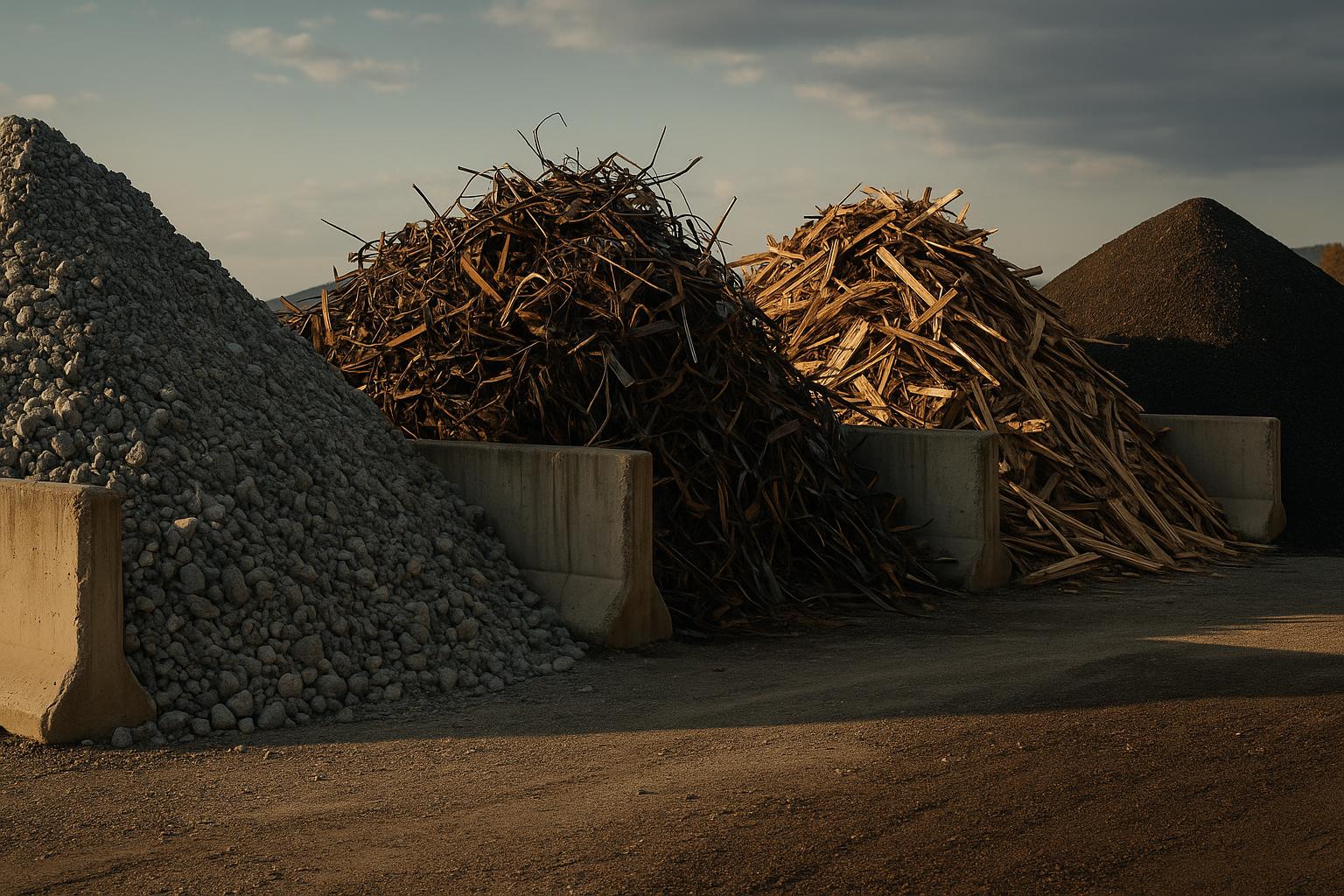
Construction and demolition waste covers everything that comes off a job site during a build, renovation, or teardown. Eight material categories make up the bulk of it.
Concrete (including rebar-reinforced). The single largest material by weight on most demo jobs. Slabs, footings, walls, foundations, curb, and gutter.
Asphalt. Parking lots, roadways, driveways, and sidewalks. Asphalt millings and chunks from surface removal.
Wood. Framing lumber, pallets, concrete forms, cleared timber, and brush from land clearing.
Metal. Rebar, structural steel, copper pipe, aluminum flashing, ductwork, and miscellaneous ferrous and non-ferrous scrap.
Brick and block. Masonry walls, CMU foundations, veneer brick, and decorative stone.
Drywall. Gypsum board from interior demo. Interior walls, ceiling panels, and partition systems.
Mixed soil and aggregate. Excavation spoils, grading material, and fill dirt with rocks, roots, or debris mixed in.
Roofing. Asphalt shingles, membrane, and built-up roofing. Limited recyclability depending on local markets.
Concrete and asphalt together account for roughly 70% of total C&D waste by weight. That means the two heaviest materials on your demo site are also the most recyclable.
What You Can Recycle On-Site vs. What Needs a Facility
Not every material can be processed where it sits. Some require specialized plants with environmental controls. Here is the breakdown.
| Material | On-Site Processing | Facility Required |
|---|---|---|
| Concrete (plain and reinforced) | YES: jaw crusher produces spec aggregate | No |
| Rock, brick, block | YES: jaw crusher processes all masonry | No |
| Mixed soil and aggregate | YES: trommel screen separates clean fractions | No |
| Wood waste (clean) | YES: air curtain burner, 95% volume reduction | No |
| Asphalt | NO: requires impact crusher or hot-mix plant | Yes |
| Metal | Segregate on-site, sell to scrap yard | Yes (processing) |
| Drywall | NO: requires gypsum recycling plant | Yes |
| Roofing shingles | NO: requires shingle recycler | Yes |
Important: jaw crushers do NOT process asphalt. Asphalt is too soft and sticky for a jaw chamber. It requires an impact crusher, which uses a completely different crushing action. This is one of the most common misconceptions in C&D recycling. If your job involves asphalt removal, that material goes to a recycling facility or gets processed with an impact crusher.
The good news: the four materials you CAN process on-site (concrete, masonry, mixed soil, and wood) typically make up 60-80% of the total tonnage on a demo job. That means most of your waste stream never needs to leave the site.
On-Site Concrete Recycling with a Portable Crusher
A portable jaw crusher is the workhorse of on-site C&D recycling. The excavator feeds broken concrete directly into the crusher hopper. The jaw chamber reduces it to sized aggregate. A cross magnet pulls rebar and steel out of the discharge stream (standard on the CT-850, optional on the CT-535).
The output: 3/4-inch minus aggregate that meets DOT specifications for base course and structural fill. This is the same material you would otherwise buy from a quarry at $8 to $15 per ton and have trucked to your site.
What a jaw crusher handles:
- Reinforced concrete slabs, walls, and footings
- CMU block and brick
- Natural rock and stone
- Mixed concrete and masonry rubble
What it does NOT handle:
- Asphalt (requires impact crusher)
- Wood or vegetative material
- Drywall or gypsum products
On a typical demo job, on-site crushing eliminates two cost lines at once. You avoid tipping fees of $35 to $55 per ton. And you avoid buying replacement aggregate at $8 to $15 per ton. That double savings is what makes the math work so well. For a detailed process walkthrough, see how on-site crushing works.
The Evortle CT-535 handles jobs under 200 tons. The Evortle CT-850 is a production machine for large commercial and municipal demo projects over 200 tons.
On-Site Soil and Aggregate Screening
Mixed material is the hidden budget killer on excavation and grading jobs. You dig up a trench or grade a pad, and the spoils are a mess of topsoil, rocks, roots, clay, and debris. Most contractors load it into trucks and haul the entire pile to a processing facility.
A trommel screen separates that pile into clean fractions on-site. Material feeds into the rotating drum. Clean topsoil drops through the screen openings. Oversized rocks, roots, and debris discharge off the end.
What you get:
- Clean topsoil for finish grading, landscaping, and final cover. No need to buy imported topsoil at $15 to $25 per cubic yard.
- Clean aggregate for base work, backfill, and drainage layers. Reuse it on the same project.
- A reject pile of roots, debris, and oversized material. This small fraction is all that needs to leave the site.
Screening works on any job with large volumes of mixed fill. Land clearing, utility trenching, mass grading, and foundation excavation all generate material that screens well.
The CZ Screen MDS MIDI is a mid-size trommel for residential and light commercial work. The Screen USA TROM 512 is a production-scale machine for high-volume screening.
On-Site Wood Waste Processing
Land clearing and demolition projects generate massive volumes of wood waste. Trees, stumps, brush, pallets, framing lumber, and concrete forms pile up fast. Hauling it out means 20 to 30 truck loads per acre of heavy clearing.
An air curtain burner processes all of that material on-site. The unit uses a high-velocity air curtain to hold combustion temperatures above 1,800 degrees F. At those temperatures, wood waste burns clean and fast.
The volume reduction is dramatic. 100 tons of wood waste becomes roughly 5 tons of clean ash. That is a 95%+ reduction. Instead of 25 truck loads to a landfill, you end up with one small pile of ash that can be spread on-site as a soil amendment.
What air curtain burners process:
- Cleared timber and stumps
- Brush and vegetative debris
- Clean construction lumber
- Pallets and concrete forms
What you must NOT burn:
- Treated lumber (CCA, ACQ, or any pressure-treated wood)
- Painted wood (lead paint risk)
- Laminated or composite materials
- Any material with adhesives, coatings, or preservatives
Air curtain burners are approved in most states where open pile burning is banned. The controlled combustion meets clean air standards that open burning cannot. Check your county and state regulations before mobilizing.
The Merris WX-5 handles smaller clearing jobs. The Merris WX-8 is sized for large-scale land clearing and disaster debris cleanup.
State C&D Diversion Requirements
Some states and municipalities set mandatory diversion rates for commercial construction and demolition projects. If you work in these jurisdictions, on-site recycling is not just a cost play. It is a compliance requirement.
Florida: Several counties require 50% or higher diversion rates on commercial projects. South Florida jurisdictions are the strictest. Landfill capacity is shrinking, and tipping fees reflect it.
Georgia: Metro Atlanta counties are pushing higher diversion targets. Cobb, Fulton, and DeKalb counties all have evolving C&D waste policies.
LEED projects: LEED certification often requires 75% diversion from landfill by weight. On a large commercial project, hitting 75% without on-site processing is nearly impossible. The trucking logistics alone make it impractical.
The practical reality: Diversion targets on paper only work if you can hit them without blowing the project budget. On-site processing with a crusher, screen, or air burner is the difference between theoretical compliance and actual compliance. You process material where it sits, track tonnage accurately, and document the diversion rate with real numbers. For the right equipment sequence on a demo job, see our site prep equipment checklist.
The Economics of On-Site C&D Recycling
Cost savings on C&D recycling come from three sources.
1. Avoided tipping fees. Every ton you process on-site is a ton that does not cross a scale house at $35 to $55 per ton. 2. Avoided trucking. No haul trips means no truck costs, no fuel, no driver time, and no wait at the landfill. 3. Recovered material value. Crushed concrete is worth $8 to $15 per ton as base material. Clean screened topsoil is worth $15 to $25 per cubic yard. These are materials you would otherwise have to purchase and import.
Here is a real-world example.
500-Ton Commercial Demo Project
Option A: Haul everything out.
| Cost Category | Calculation | Total |
|---|---|---|
| Tipping fees | 500 tons x $45/ton avg | $22,500 |
| Trucking | 25 loads x $165/load | $4,125 |
| Loading time | 12 hours x $225/hr | $2,700 |
| Driver wait time | 25 loads x 45 min x $95/hr | $1,781 |
| Replacement base material | 300 tons x $15/ton | $4,500 |
| Replacement topsoil | 50 yd3 x $20/yd3 | $1,000 |
| Total haul-out cost | $36,606 |
Option B: Process on-site with a crusher, screen, and air burner.
| Cost Category | Calculation | Total |
|---|---|---|
| Crusher rental (2 weeks) | Evortle CT-850 | $9,800 |
| Trommel rental (1 week) | Screen for mixed soil | $3,500 |
| Fuel for both machines | $1,800 | |
| Operators (if needed) | 2 weeks | $2,400 |
| Haul residual waste (drywall, metal, roofing) | 5 loads x $165 | $825 |
| Residual tipping fees | 50 tons x $45/ton | $2,250 |
| Total on-site processing cost | $20,575 |
Net savings: $16,031. That is a 44% reduction in disposal cost.
But you also kept roughly 300 tons of crushed aggregate on-site worth $4,500 to $5,400 in material value. And you kept clean topsoil on-site worth another $1,000. If you reuse those materials on the same project, your total economic advantage climbs to $21,000 or more.
The savings scale with tonnage. At 200 tons, expect $8,000 to $10,000 in net savings. At 1,000 tons, the numbers get dramatic. On-site processing consistently cuts total disposal cost by 40-60% on jobs over 100 tons.
Start Recycling C&D Waste On-Site
Every ton you recycle on-site is a ton you do not pay to haul or dump. It is also a ton of material you do not have to buy from somewhere else.
GrinderCrusherScreen has connected contractors with portable crushers, trommel screens, and air burners since 1973. Tell us about your project: tonnage, material mix, location, and timeline. We will match you with the right equipment and get you a quote.
Call 770-433-2670 to get matched with a provider, or browse equipment by type:
- Concrete crushers | Available in Tampa, Nashville, Charlotte
- Trommel screens
- Air burners
Looking to buy equipment instead of rent? Browse the full inventory at GrinderCrusherScreen.com.