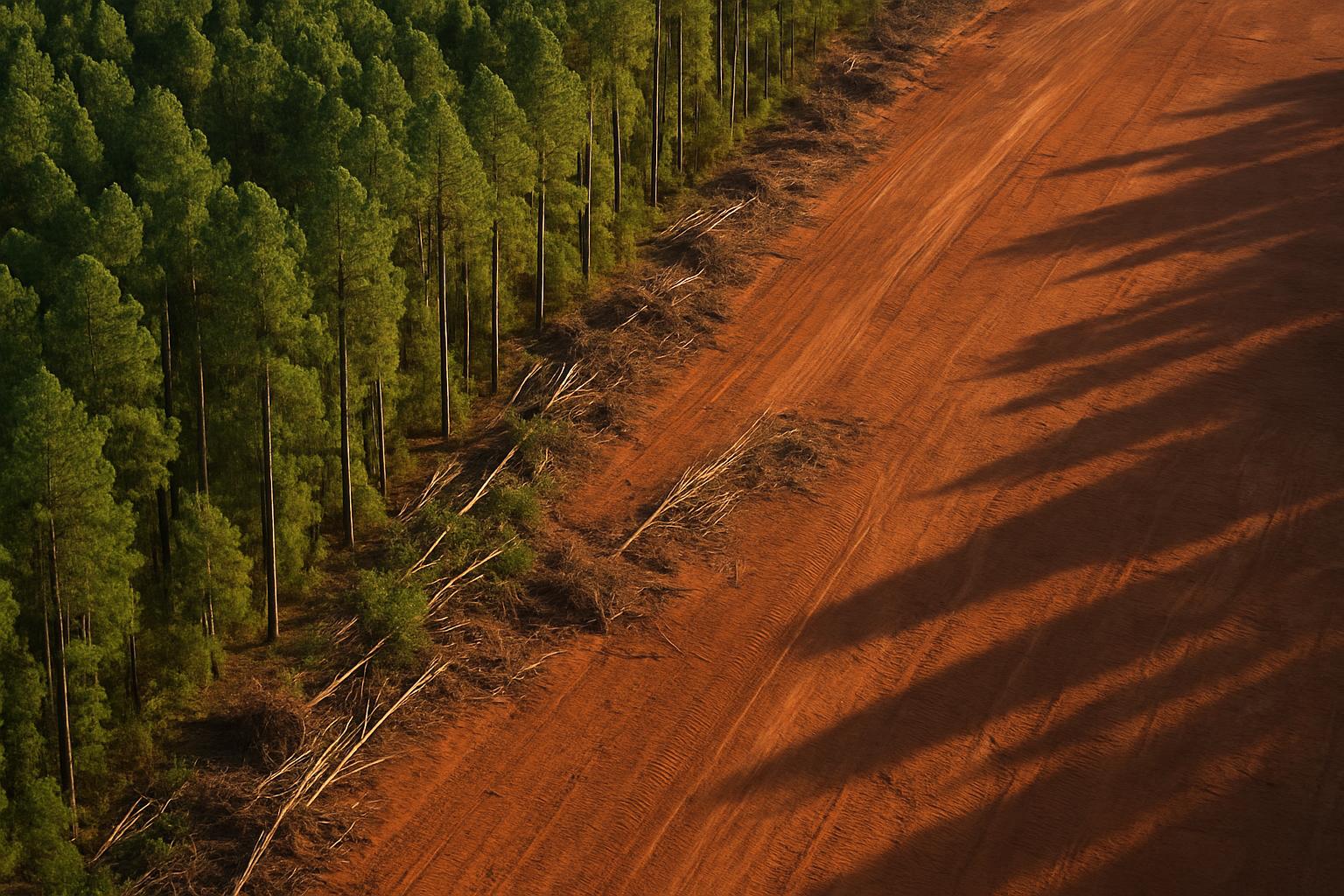
Land clearing runs $1,200 to $6,000+ per acre in the Southeast. The price depends on terrain, tree density, and how you handle the debris. That last one is where most contractors bleed money.
A flat acre of brush with no trees? Two guys and a mulcher knock it out before lunch. Forty acres of hardwood with 14-inch oaks and root balls the size of truck beds? That is a different job entirely.
This guide breaks down real per-acre costs by terrain type, explains the cost drivers most contractors underestimate, and shows how the right equipment turns your biggest expense into your smallest line item.
Average Land Clearing Cost Per Acre by Terrain Type
These numbers reflect contractor-to-contractor pricing across Florida, Georgia, Alabama, Tennessee, and the Carolinas. Costs are for clearing only. They do not include grading, site prep, or erosion control.
| Terrain Type | Cost Per Acre |
|---|---|
| Light brush and grass | $1,200 – $2,000 |
| Mixed brush and small trees (under 6″ diameter) | $2,000 – $3,500 |
| Moderate timber (6-12″ diameter, 100-200 trees/acre) | $3,500 – $5,000 |
| Heavy timber (12″+ diameter, dense canopy) | $5,000 – $8,000 |
| Heavy timber with stumps and grubbing | $6,000 – $10,000+ |
The gap between “light brush” and “heavy timber with grubbing” is a 5x to 8x difference. Most of that gap comes from two things: machine hours and debris volume.
What Drives Land Clearing Cost
Six factors push land clearing cost per acre up or down. Know them before you bid.
Tree density and diameter. More trees means more machine hours. A 6-inch pine falls in one pass. A 16-inch oak takes multiple cuts, directional felling, and more time on the ground. Dense canopy lots at 200+ trees per acre can double your clearing time compared to 80 trees per acre.
Stump removal vs. grind-in-place. Grinding stumps flush adds $500 to $1,000 per acre. Full grubbing (pulling root balls out of the ground) adds $1,000 to $1,500 per acre. If the site goes to pasture or timber replanting, you can often leave stumps in place. If it goes to construction with footings, they have to come out.
Debris disposal method. This is the number one hidden cost on any land clearing job. More on this below.
Terrain. Slopes over 15% slow every machine on the site. Wet ground means wider tracks or mats. Rocky soil kills grubbing productivity. Any of these conditions can add 20-40% to your base clearing cost.
Access. Narrow residential lots limit equipment size. Utility easements restrict where you can fell timber. Tight access means smaller machines, slower work, and more hand labor. A job with 200 feet of frontage clears faster than the same acreage on a flag lot with a 20-foot driveway.
Permits. Burn permits cost $0 to $50 in most Southeast states. See our state-by-state open burning permit guide for detailed requirements by state. Erosion control plans, tree preservation ordinances, and county-specific clearing permits can add $500 to $2,000 in compliance costs before you cut the first tree. Metro counties in Georgia and Florida are stricter than rural counties.
The Debris Problem: Where Land Clearing Gets Expensive
Here is the math most contractors miss when they bid land clearing work.
A single acre of moderate timber produces 80 to 150 tons of wood waste. Tops, limbs, trunks, brush, and slash. It all has to go somewhere.
Your options:
Chip and haul. Bring in a chipper or horizontal grinder, reduce everything to chips, truck it to a disposal site or mulch yard. Cost: $800 to $1,500 per acre depending on haul distance and tipping fees.
Whole-log removal. Buck the merchantable timber and haul logs to a sawmill or pulpwood yard. Cost: $500 to $1,000 per acre. This only works if the timber has value. Pine pulpwood prices in the Southeast have fallen sharply, down 22% year-over-year and 46% below the 2022 peak. Some mills will not take hardwood under 8 inches.
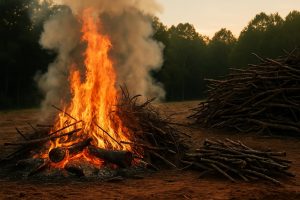
Slash pile burning. Stack it and burn it. Cost: free, if your county still allows open pile burning. Many metro and suburban counties have banned it or restricted it to winter months only.
Now run the numbers on hauling. Say you clear 10 acres of moderate timber. That is 1,000 tons of wood waste. At $35 per ton in tipping fees plus $200 per load for trucking (25-ton trailers), you are looking at:
- Tipping fees: 1,000 tons x $35 = $35,000
- Trucking: 40 loads x $200 = $8,000
- Total disposal cost: $43,000
That is $4,300 per acre just for disposal. On a job where the clearing itself costs $4,000 per acre, disposal just doubled your total cost.
Every additional mile of haul distance adds cost per ton. A disposal site 30 miles away costs meaningfully more than one 10 miles away. And if the closest vegetative waste facility is booked out two weeks, you are paying for idle time while your slash piles sit.
How Air Curtain Burners Cut Debris Disposal Costs
An air curtain burner processes wood waste on site. You feed trees, stumps, brush, and slash directly into the burn box. A high-velocity air curtain forces complete combustion. Smoke drops to near zero. The fire burns at 1,800 degrees or higher.
The results change the job economics completely.
Volume reduction: 95% or more. One hundred tons of wood waste becomes roughly 5 tons of clean ash. That ash stays on site as a soil amendment or gets hauled in a single truck. Compare that to 40 haul trips for the same material.
No tipping fees. Nothing leaves the site. No disposal facility charges.
No waiting for chip trucks. Your clearing crew keeps working instead of standing around waiting for the next empty trailer.
Approved where open pile burning is restricted. Air curtain burners meet EPA and state air quality standards. Most Southeast states permit them in counties where open burning is banned. They produce a fraction of the particulate matter that an open burn produces.
The Merris WX-5 handles residential and small commercial clearing jobs. It is the right size for 1 to 10 acre projects with moderate timber. The Merris WX-8 handles large-scale commercial clearing and utility right-of-way projects where you are processing 48 to 72 tons per day in a full work day.
Here is the comparison that matters. Renting an air burner for a 10-acre clearing job costs less than hauling the debris off one acre. On the job above, you would spend $43,000 hauling. An air burner rental for the same project duration runs a fraction of that.
Looking to buy instead of rent? GCS distributes both the WX-5 and WX-8 through the parent site.
When You Need a Crusher Too
Land clearing is not always just trees and brush. Commercial sites often have old building foundations, concrete pads, sidewalks, or abandoned driveways buried in the dirt.
A portable jaw crusher turns that concrete into reusable aggregate on site. The material comes out sized for road base, backfill, or pipe bedding. That saves you twice.
First, you skip hauling concrete debris to a C&D landfill. Concrete disposal runs $25 to $65 per ton at most Southeast facilities. A 6-inch slab over a half-acre pad produces roughly 800 tons of concrete. At $45 per ton in tipping fees, that is $36,000 in disposal alone.
Second, you stop buying imported base material. Crushed aggregate runs $15 to $25 per ton delivered. If you need 800 tons of base for the same site, you just saved another $12,000 to $20,000 by reusing what you crushed.
The Evortle CT-535 handles residential foundations and smaller commercial pads. The CT-850 handles large commercial and industrial demo. Both are jaw crushers built for concrete, rock, and brick. They do not process asphalt. Impact crushers handle asphalt.
This setup is common on commercial land clearing where existing structures are being removed before new construction. Clear the timber with a mulcher, burn the slash with an air burner, crush the concrete with a jaw crusher. Three pieces of equipment, zero haul trips.
Land Clearing Cost by State (Southeast)
Costs vary state to state. Here is what drives the difference.
Florida. Highest vegetative tipping fees in the region. Some facilities charge $40 to $50 per ton. Burn permits go through the Florida Forest Service. Wet season (June through October) adds cost on low-lying sites. Many counties require tree surveys before clearing. See Florida equipment availability.
Georgia. Moderate costs overall. EPD burn permits required in metro Atlanta counties (Fulton, DeKalb, Gwinnett, Cobb). Rural counties are more flexible. Tipping fees run $25 to $40 per ton. Georgia Forestry Commission handles burn permits outside metro areas. See Georgia equipment availability.
Alabama. Lowest tipping fees in the region at $20 to $30 per ton. Alabama Forestry Commission issues burn permits. Less restrictive clearing regulations in most counties. Labor rates run lower than Georgia and Florida.
Tennessee. Costs vary sharply by region. West Tennessee (flat farmland) clears cheaply. East Tennessee (mountain terrain, rocky soil, steep grades) adds 30-50% to base clearing costs. Tennessee Division of Forestry handles burn permits. Erosion controls tighten near waterways.
North Carolina. The NC Forest Service (under the Department of Agriculture) issues burn permits. DEQ handles air quality compliance separately. Stricter erosion control requirements than neighboring states. Sedimentation and Pollution Control Act applies to any land disturbance over one acre. Tipping fees run $30 to $45 per ton.
South Carolina. The Forestry Commission manages burn notifications (not permits). You notify the commission before burning at scfc.gov. Moderate tipping fees at $25 to $35 per ton. Coastal counties (Charleston, Beaufort, Horry) have stricter tree preservation ordinances than upstate counties.
Get the Right Equipment for Your Clearing Job
Debris handling is the swing factor on every land clearing bid. The contractors who make money on clearing jobs are the ones who process material on site instead of paying someone else to haul it away.
GCS has connected contractors with air burner and crusher rentals across the Southeast since 1973. Tell us about your project: acreage, terrain, timber density, and any concrete or structures on site. We match you with the right equipment and a provider in your area.
Call 770-433-2670 to get connected with equipment for your next clearing project.
Or visit our equipment pages:
- Air Burner Rentals for wood waste disposal
- Concrete Crusher Rentals for foundation and slab removal
- Air burner rentals in Atlanta, Jacksonville, and Nashville